
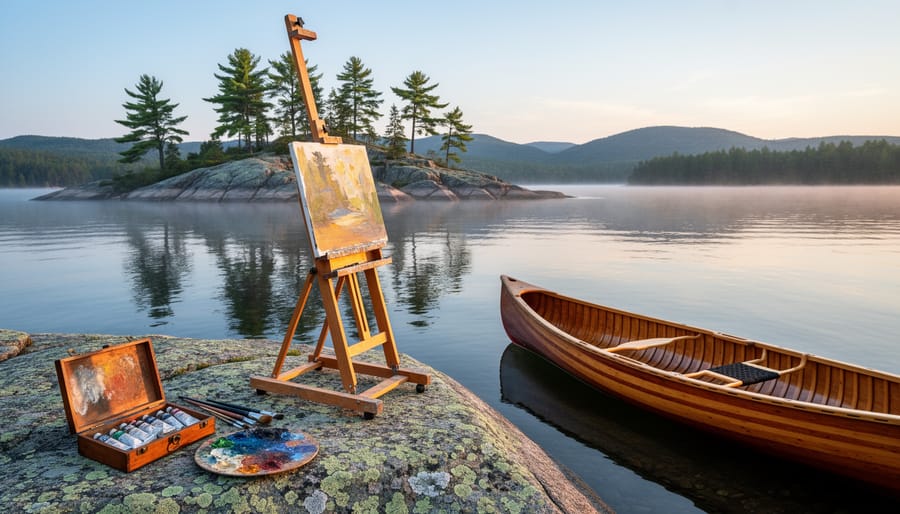
Between 1920 and 1933, seven Canadian painters revolutionized how an entire nation saw itself. Tom Thomson, Lawren Harris, J.E.H. MacDonald, Arthur Lismer, Frederick Varley, Frank Johnston, and Franklin Carmichael didn’t just create art. They forged a visual language that transformed the rugged Canadian wilderness from an intimidating frontier into a source of fierce national pride.
Their bold, expressive landscapes captured the untamed beauty of northern Ontario, Georgian Bay, Algoma, and the Rocky Mountains with a raw intensity that rejected European artistic traditions. Using vibrant colors and dynamic brushstrokes, these artists ventured into remote regions by canoe and train, translating their firsthand encounters with Canada’s vast terrain into paintings that still resonate today.
What began as informal sketching trips among friends became a formal movement in 1920, when the Group of Seven held their first exhibition at the Art Gallery of Toronto. Critics initially dismissed their work as crude and unfinished. The public, however, saw something different: honest reflections of their own country rendered with authenticity and power.
Today, their paintings hang in major museums across Canada and command remarkable prices at auction, recognized as defining artifacts of Canadian cultural heritage. These works represent more than artistic achievement. They capture a pivotal moment when Canada began establishing its own cultural identity, separate from colonial influences. Understanding the Group of Seven means understanding how a nation learned to see itself through the eyes of artists who dared to paint Canada on its own terms.
Origins: A Revolutionary Vision Takes Shape
The Studio Building and Early Collaborations
In 1914, a remarkable architectural undertaking changed the course of Canadian art forever. The Studio Building in Toronto designed by artist and architect Eden Smith, opened its doors on Severn Street in the Rosedale ravine. Financed by Dr. James MacCallum and Lawren Harris, this purpose-built facility provided spacious, well-lit studios where artists could work through harsh Canadian winters.
The building became more than just workspace. Within its walls, artists who would later form the Group of Seven gathered regularly to sketch, debate artistic philosophy, and challenge conventional approaches to Canadian landscape painting. Tom Thomson, though he never lived to see the group’s official formation, occupied Studio One and became a driving force in these early conversations. His bold brushwork and passionate renderings of the northern wilderness inspired his colleagues profoundly.
Harris and J.E.H. MacDonald were among the first tenants, soon joined by A.Y. Jackson, Arthur Lismer, and Frederick Varley. These artists shared more than studio space. They critiqued each other’s work, discussed European modernist movements, and debated how to capture Canada’s unique character on canvas. Sketching trips to Algonquin Park and Georgian Bay became collaborative expeditions, with artists painting side by side and sharing techniques.
The Studio Building fostered an environment where experimentation thrived. Here, the distinctive aesthetic that would define the Group of Seven took shape through countless hours of work, discussion, and mutual encouragement.

The Seven Artists Who Defined a Nation
The founding members of the Group of Seven each brought distinct artistic voices to the collective vision of capturing Canada’s untamed landscapes. Their individual talents and perspectives created a movement greater than the sum of its parts, transforming how Canadians understood their own geography.
Lawren Harris emerged as the group’s philosophical and financial anchor. Born into the wealthy Massey-Harris family, he used his privilege to support fellow artists while developing a spiritual approach to landscape painting. His stark, geometric mountain scenes from the Rockies stripped nature down to essential forms bathed in transcendent light. Harris believed that art could serve as a pathway to higher consciousness, and his later work moved increasingly toward abstraction. The National Gallery of Canada houses many of his most significant pieces, including the haunting Lake Superior canvases that capture the northern shore’s severe beauty.
A.Y. Jackson, the group’s longest-lived member, was its tireless traveler and chronicler. He survived the horrors of the First World War and carried that experience into his art, finding solace in the Canadian wilderness. Jackson’s rolling hills and farmland scenes, particularly of Quebec’s countryside, employed bold, rhythmic brushstrokes that gave the landscape an almost musical quality. He painted into his late eighties, producing thousands of sketches across seven decades.
Frank Johnston stayed with the group for only its first exhibition before pursuing a successful commercial career. His meticulous attention to detail and more conservative style set him apart, yet works like “Fire-Swept, Algoma” demonstrated his ability to capture dramatic natural moments with technical precision.
| Artist | Signature Style | Iconic Work | Key Collection |
|---|---|---|---|
| Lawren Harris | Geometric mountains, spiritual light | North Shore, Lake Superior | National Gallery of Canada |
| A.Y. Jackson | Rolling landscapes, rhythmic brushwork | The Red Maple | National Gallery of Canada |
| Franklin Carmichael | Watercolors, Ontario hills | A Northern Silver Mine | McMichael Canadian Art Collection |
| Arthur Lismer | Windswept pines, Georgian Bay | September Gale | National Gallery of Canada |
| J.E.H. MacDonald | Rich color, decorative elements | The Tangled Garden | National Gallery of Canada |
Arthur Lismer became the group’s educator and public advocate. His windswept pines clinging to Georgian Bay rocks became iconic symbols of Canadian resilience. Lismer dedicated himself to art education, developing programs that brought creative expression to children and helped democratize art appreciation across the country.
J.E.H. MacDonald served as the group’s elder statesman and spiritual guide. His lush, decorative style drew inspiration from Art Nouveau and showed particular sensitivity to color harmonies. “The Tangled Garden” revealed his ability to find grandeur in intimate spaces, while his Algoma sketches captured wilderness with emotional intensity.
Franklin Carmichael, the youngest member, excelled in watercolor technique and brought a lyrical quality to Ontario’s gentler hills. Though less celebrated during his lifetime, his meticulous craftsmanship and sensitive color work have gained increasing recognition. The McMichael Canadian Art Collection features an extensive Carmichael collection.
Frederick Varley brought portraiture skills and a darker, more introspective sensibility. His war paintings confronted death and suffering directly, while his British Columbia mountain scenes explored more somber atmospheric conditions than his colleagues preferred. Varley’s psychological depth added complexity to the group’s collective output.
Tom Thomson: The Spiritual Eighth Member
Tom Thomson never lived to see the Group of Seven’s formation in 1920, yet his presence permeates their legacy like few other figures in Canadian art history. He died on 8 July 1917 under mysterious circumstances in Canoe Lake, Algonquin Park, three years before his colleagues would officially band together. The tragedy robbed Canadian art of one of its most promising talents at age 39.
Despite his absence at the group’s founding, Thomson’s influence shaped everything the Seven would become. His bold interpretation of the Canadian wilderness, his unconventional techniques, and his passionate dedication to capturing the spirit of the northern landscape set the template his friends would follow. Working alongside future Group members like J.E.H. MacDonald, Arthur Lismer, and Franklin Carmichael at Toronto’s Grip Ltd. design firm, Thomson developed the visual language that would define Canadian modernist painting.
His intimate knowledge of Algonquin Park proved invaluable. Thomson worked as a fire ranger and fishing guide, gaining an understanding of the landscape that went far beyond what weekend excursions could provide. This authenticity shows in masterworks like “The Jack Pine” and “The West Wind,” paintings that capture not just the visual appearance of Canada’s wilderness but its essence.
The circumstances surrounding his death remain unresolved, spawning decades of speculation about whether he drowned accidentally, took his own life, or met with foul play. What’s certain is the profound loss his friends felt. When the Group of Seven finally assembled, they considered Thomson their spiritual founder, the artist who had shown them the way forward. His paintings hang in major Canadian institutions today, recognized as national treasures that helped define how Canadians see themselves and their landscape.
Painting the Canadian Wilderness: Techniques and Innovations
From Algonquin Park to the Arctic Circle
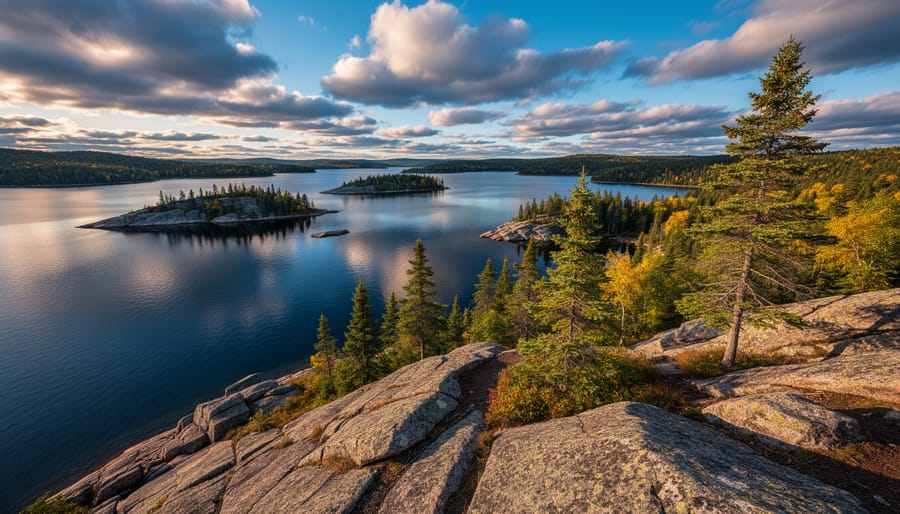
The Group of Seven didn’t confine their artistic vision to a single landscape. They believed that Canada’s vastness and diversity demanded comprehensive exploration, and their painting expeditions reflected this ambition with remarkable scope.
Algonquin Park served as their initial laboratory, where Tom Thomson pioneered the bold techniques his colleagues would later adopt. The park’s accessible wilderness, with its rocky shorelines and dense forests, became their training ground. But the Group quickly expanded their territorial reach, driven by a conviction that capturing Canada’s essence required witnessing its full geographic spectrum.
Their expeditions carried them across the nation:
- Georgian Bay’s windswept pines and pink granite shores, painted extensively by A.Y. Jackson and Arthur Lismer
- Lake Superior’s dramatic cliffs and moody skies, immortalized in Lawren Harris’s stark compositions
- The Rocky Mountains of Alberta and British Columbia, where Harris found spiritual transcendence in towering peaks
- Northern Ontario’s mining towns and autumn forests, captured by Franklin Carmichael and J.E.H. MacDonald
- The Arctic tundra and Baffin Island, explored by Harris and Jackson in 1930, pushing the boundaries of accessible Canadian landscape
These journeys often involved considerable hardship. Jackson travelled to the Yukon and Great Slave Lake by canoe and on foot. Harris ventured into the Arctic aboard supply ships. They camped in remote locations, battled insects, and hauled painting equipment through trackless wilderness.
This geographic diversity distinguished the Group from other national art movements. They didn’t romanticize a single iconic landscape. Instead, they documented Canada’s multiple identities, from the gentle hills of southern Ontario to the severe beauty of the subarctic, creating a visual archive that reflected the nation’s true continental scale.
Controversy and Criticism: Not Everyone Was Convinced
When the Group of Seven first exhibited their bold landscapes in 1920, the Canadian art establishment recoiled. Critics accustomed to European refinement and polished technique dismissed the paintings as crude, garish, and worse. Hector Charlesworth, an influential Toronto critic, famously derided their work as “Hot Mush” school painting, mocking what he saw as violent colours and unfinished compositions. The Toronto Star declared their canvases looked like they’d been “thrown” at the viewer rather than carefully painted.
Academic institutions and conservative galleries initially refused to take the Group seriously. The Royal Canadian Academy, representing traditional artistic values, viewed their rough brushwork and intense palette as affronts to proper artistic training. Many established painters believed Lawren Harris, J.E.H. MacDonald, and their colleagues were deliberately courting controversy rather than pursuing genuine artistic vision. MacDonald faced particularly vicious attacks after exhibiting “The Tangled Garden” in 1916, with one reviewer suggesting he’d simply smeared paint haphazardly across the canvas.
The public reaction proved equally divided. Gallery visitors accustomed to pastoral scenes and European-inspired portraits found the Group’s depictions of raw Canadian wilderness jarring and unpleasant. Some accused them of creating propaganda rather than art, questioning whether these stylized landscapes truly represented Canada at all. Letter writers to newspapers complained about tax dollars potentially supporting such “radical” work.
But the controversy fueled interest. Younger Canadians and progressive collectors began championing the Group’s fresh perspective. What critics called primitive, supporters celebrated as authentically Canadian. The fierce debate actually helped cement their reputation, transforming initial rejection into a movement that would fundamentally reshape how Canadians saw their own land and cultural identity.
Their Works as Historical Artifacts: Preservation and Display
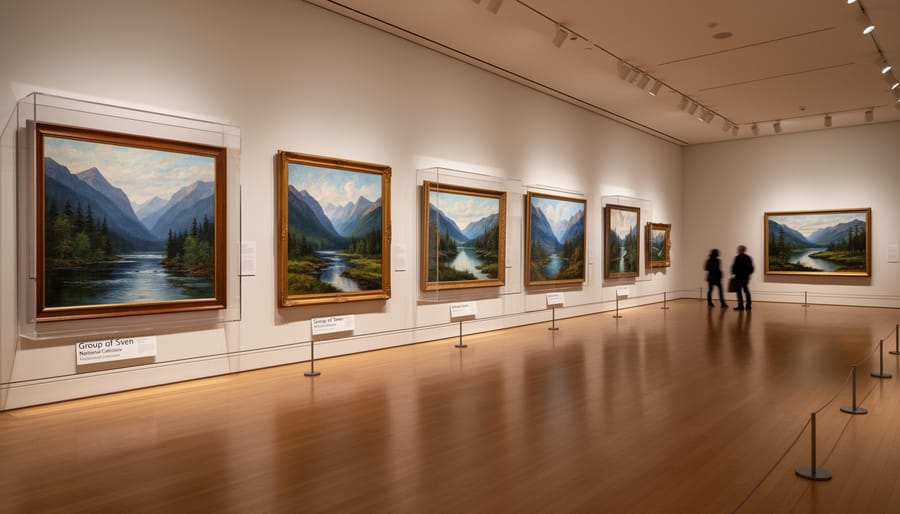
The paintings of the Group of Seven have evolved from controversial modern art into treasured national artifacts, now carefully safeguarded within Canada’s most prestigious institutions. The National Gallery of Canada houses the most comprehensive collection, with over 400 works representing each member’s contribution to the movement. Visitors to Ottawa can walk through dedicated galleries where iconic canvases like Lawren Harris’s “North Shore, Lake Superior” hang alongside A.Y. Jackson’s vibrant autumn landscapes.
The Art Gallery of Ontario in Toronto offers another remarkable collection, featuring more than 300 Group of Seven paintings acquired through strategic purchases and generous donations from the artists themselves and their families. Regional museums have also become crucial custodians of this legacy. The McMichael Canadian Art Collection in Kleinburg, Ontario, was specifically designed to showcase the Group’s work, while western institutions like the Winnipeg Art Gallery and Vancouver Art Gallery ensure these paintings remain accessible across the country.
Preservation efforts have intensified as these paintings age. Conservators employ advanced techniques to stabilize century-old canvases, analyzing pigments and addressing environmental damage. The Archives of Manitoba has collaborated with galleries to digitize sketches and preparatory works, creating research databases that scholars worldwide can access. This commitment to cultural heritage preservation extends beyond the paintings themselves to include the artists’ correspondence, photographs, and camping equipment.
Many works have achieved formal protected status under provincial and federal heritage legislation. Insurance valuations now reach millions of dollars for individual pieces, reflecting both their artistic merit and cultural significance. These aren’t simply old paintings. They’re defining symbols of Canadian identity, requiring the same careful stewardship we give to historical buildings and archaeological treasures.
Beyond Canvas: The Group’s Lasting Cultural Impact
The Group of Seven transformed more than Canadian art. They fundamentally reshaped how an entire nation sees itself. Their bold vision of the northern wilderness became inseparable from Canadian identity, offering a visual language that united citizens across a geographically vast and culturally diverse country.
Walk into any Canadian classroom, and you’ll likely find reproductions of their paintings adorning the walls. The iconic images appear on everything from postage stamps to currency. In 1995, the Canadian government featured Lawren Harris’s “North Shore, Lake Superior” on a stamp, while A.Y. Jackson’s work graced Canadian bills. These aren’t just design choices. They represent official endorsement of the Group’s vision as the nation’s visual identity.
Their influence extends far beyond gallery walls into the tourism industry. Algonquin Park, Killarney Provincial Park, and Georgian Bay attract visitors specifically seeking the landscapes immortalized in Group of Seven paintings. People stand where Tom Thomson once stood, searching for the exact view he captured. Parks Canada and provincial tourism boards actively market these connections, understanding that the paintings created a powerful mythology around Canadian wilderness.
Educational institutions, including the Art Gallery of Ontario and the McMichael Canadian Art Collection, have built significant programming around these works, ensuring new generations understand their cultural importance. School curricula across Canada include the Group’s story, making them among the few artists every Canadian learns about.
The paintings continue sparking conversations about what makes Canada distinctly Canadian. They established wilderness, ruggedness, and northern identity as core national values. While contemporary discussions rightfully expand to include Indigenous perspectives and more diverse artistic voices, the Group of Seven’s influence on Canadian cultural consciousness remains undeniable. Their vision persists in how Canadians understand their landscape and themselves.
Experiencing the Legacy Today
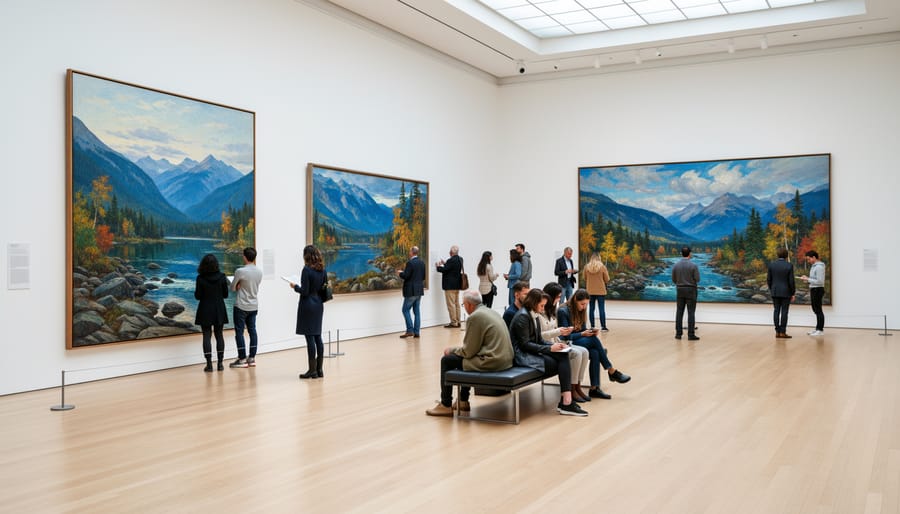
Canada’s Group of Seven legacy lives on through numerous cultural institutions and historic sites that invite visitors to connect with these pioneering artists and their vision of the Canadian landscape. The Art Gallery of Ontario in Toronto houses the world’s most comprehensive collection of Group of Seven works, with dedicated galleries displaying iconic paintings alongside archival materials and sketches that reveal the artists’ creative processes. The McMichael Canadian Art Collection in Kleinburg, Ontario, offers an equally immersive experience, set on 100 acres of conservation land that mirrors the wilderness scenes depicted in the paintings.
For those seeking authentic encounters with Group of Seven painting locations, several sites welcome modern-day pilgrims. Algonquin Provincial Park preserves many of the landscapes Tom Thomson and his colleagues immortalized, with interpretive trails and canoe routes marked to guide visitors to specific vantage points. The Studio Building on Severn Street in Toronto, where several members worked, stands as a National Historic Site.
Must-visit museums and historic sites include:
- National Gallery of Canada in Ottawa, featuring rotating exhibitions and permanent Group of Seven galleries
- Tom Thomson Art Gallery in Owen Sound, Ontario, showcasing the artist’s development and regional influence
- Lawren Harris’s former studio and residence in Toronto’s Rosedale neighbourhood
- Vancouver Art Gallery, which holds significant works by British Columbia-connected members
Many institutions offer educational programming, including painting workshops in historic locations, curator-led tours, and digital resources for students. Parks Canada operates heritage programs at key sites, while provincial galleries across Canada collaborate on touring exhibitions that bring Group of Seven works to communities nationwide.
The Group of Seven transformed how Canadians see their own landscape. Their bold canvases captured the raw power of the Canadian Shield, the vastness of northern lakes, and the resilience of windswept pines in ways that previous artists hadn’t dared attempt. These paintings endure as vital historical artifacts because they represent more than artistic achievement. They embody a crucial moment when Canada sought to establish its cultural independence and define itself through its own geography rather than European traditions.
Today, their works continue shaping national identity, appearing on everything from currency to coffee table books. Museums across the country hold these treasures, with institutions like the Art Gallery of Ontario, McMichael Canadian Art Collection, and National Gallery of Canada offering extensive collections. Many galleries provide newsletters highlighting upcoming exhibitions and educational programs that bring these historical artifacts to life for new generations.
For those inspired to experience these masterpieces firsthand, consider visiting the landscapes that inspired them. Algonquin Park, Georgian Bay, and Lake Superior’s northern shores remain largely unchanged since Lawren Harris and Tom Thomson set up their easels there a century ago. Walking these trails offers profound connection to Canada’s artistic heritage and the wild beauty that continues defining our national character.