

From clandestine card games in frontier saloons to the digital revolution of platforms like blaze bet br, Canadian gambling has traversed a remarkable journey spanning over 150 years. This evolution mirrors the nation’s broader transformation—from colonial outpost to modern multicultural society—where games of chance shifted from moral taboo to regulated entertainment industry worth billions annually.
The story of Canadian sports betting and casino history reveals far more than legislation and lottery tickets. It exposes deep cultural tensions between provincial autonomy and federal authority, chronicles Indigenous gaming traditions predating European contact, and documents how technological innovation repeatedly disrupted established gambling paradigms. From the 1892 Criminal Code amendments that first addressed betting laws to the 2021 legislation that legalized single-event sports wagering, each milestone reflects changing Canadian values about personal freedom, government revenue, and social responsibility.
Understanding this history illuminates why Canadians today navigate a uniquely complex gambling landscape where provincial lottery corporations operate alongside Indigenous gaming facilities, offshore platforms compete with emerging legal sportsbooks, and century-old charitable gaming models persist alongside cutting-edge live dealer technology. This historical context proves essential for comprehending current debates about gambling regulation, addiction prevention, and the industry’s economic impact across all Canadian regions—from Atlantic fishing communities to Prairie agricultural towns and Pacific coastal cities.
When Betting Was a Crime: Canada’s Early Gambling Laws

The 1892 Criminal Code and Its Impact
Canada’s 1892 Criminal Code marked a pivotal turning point in the nation’s relationship with gambling, establishing comprehensive prohibitions that would shape recreational activities for generations. Section 197 explicitly criminalized operating common gaming houses, while Section 198 targeted betting houses and pool selling operations. These provisions effectively outlawed most forms of gambling, including sports wagering and card games conducted for profit, reflecting Victorian-era moral concerns that viewed gambling as a societal vice threatening family stability and economic productivity.
The enforcement of these laws, however, revealed the vast geographic and cultural diversity of the young Dominion. In Ontario and Quebec, urban police forces actively raided underground betting establishments, particularly during horse racing seasons. Meanwhile, remote territories like Yukon and the Northwest Territories saw minimal enforcement, with Royal Canadian Mounted Police priorities focusing on more pressing frontier concerns. Maritime provinces adopted a middle approach, occasionally prosecuting high-profile operators while tolerating informal wagering among fishing communities.
This uneven application created a patchwork of gambling experiences across Canada. British Columbia’s port cities witnessed persistent underground activity despite periodic crackdowns, while Prairie communities developed informal betting networks around agricultural fairs. The practical reality of enforcement challenges would eventually pressure legislators to reconsider absolute prohibition, setting the stage for twentieth-century reforms that acknowledged Canadians’ enduring interest in games of chance.
Underground Betting Culture in Early Canada
Despite government prohibitions, Canadians from coast to coast maintained a vibrant underground betting culture throughout the early twentieth century. Much like the speakeasies that served alcohol during Prohibition, clandestine gambling establishments operated in back rooms of legitimate businesses, private homes, and exclusive clubs across major cities like Montreal, Toronto, and Vancouver.
Illegal bookmakers became fixtures in Canadian communities, accepting wagers on horse racing, hockey, and baseball through networks of trusted intermediaries. These operators used coded language and discreet signals to avoid detection by law enforcement. In mining towns and prairie settlements, workers gathered in poolrooms and barbershops where bookies quietly recorded bets in ledgers hidden from public view.
Horse racing remained particularly popular, with Canadians finding creative ways to place bets at tracks and through off-site bookmakers. The sport’s cultural significance meant that even during periods of strict prohibition, racing continued with authorities often turning a blind eye to wagering activities.
This underground economy flourished partly due to inconsistent enforcement and partly because gambling held deep roots in Canadian social life. From kitchen table poker games to elaborate betting syndicates, these informal networks demonstrated that legislative restrictions could not suppress the public’s appetite for gambling. This persistent demand would eventually pressure governments to reconsider their regulatory approaches, recognizing that controlled legalization might better serve public interests than futile prohibition.
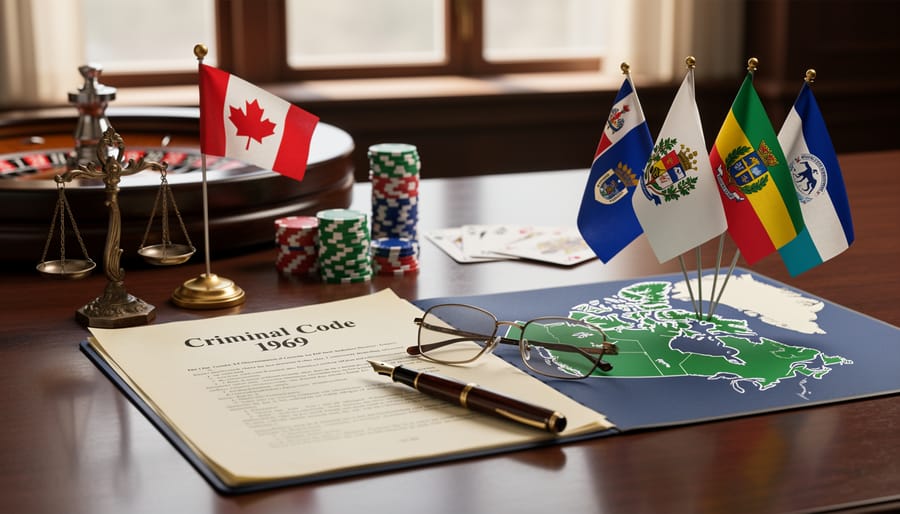
The 1969 Turning Point: When Provinces Gained Control
Why the Federal Government Changed Course
By the 1960s, mounting pressure from provincial governments and shifting public sentiment convinced federal authorities to reconsider gambling’s legal status. The post-war era brought profound social change across Canada, as citizens increasingly questioned outdated moral legislation. Provincial premiers recognized the substantial revenue potential that regulated gambling could generate for healthcare, education, and infrastructure projects during a period of rapid expansion.
Economic factors proved particularly compelling. Canadians were already gambling through illegal operations and cross-border excursions, meaning billions in potential tax revenue flowed elsewhere. Quebec’s successful experiment with government lotteries in 1968 demonstrated that regulated gambling could operate without moral catastrophe, providing a practical model for other provinces. This development mirrored broader patterns in Canada’s regulatory evolution regarding previously prohibited activities.
Political realities also shifted dramatically. The 1967 centennial celebrations fostered national confidence and willingness to chart distinctly Canadian paths on social policy. Provincial governments demanded greater autonomy over recreational activities within their borders, arguing that one-size-fits-all federal restrictions ignored regional values and needs. These converging forces created an irresistible momentum toward decriminalization, culminating in the landmark 1969 Criminal Code amendments that forever transformed Canadian gambling.
Provincial Responses Across the Nation
Following the 1969 Criminal Code amendments, provinces approached their newfound gambling authority with remarkably different strategies, reflecting regional cultures and political philosophies. Quebec and Ontario emerged as early innovators, with Quebec launching Loto-Québec in 1970 and quickly establishing itself as a national leader in gaming modernization. The province’s approach blended European-style sophistication with pragmatic revenue generation, opening the Montreal Casino in 1993 as a flagship entertainment destination.
Ontario followed closely, creating the Ontario Lottery Corporation in 1975 and later introducing charitable casino gaming in the 1990s. The province’s measured expansion balanced economic opportunity with social responsibility concerns, establishing frameworks that other regions would later adapt.
Western provinces displayed cautious optimism. British Columbia formed the British Columbia Lottery Corporation in 1985, while Alberta and Manitoba developed their own provincial corporations throughout the 1970s and 1980s. These provinces emphasized community benefit and charitable connections in their gambling programs.
The Atlantic provinces adopted more conservative timelines, with some jurisdictions waiting decades before fully embracing casino gaming. This regional variation created a patchwork of gambling landscapes across Canada, each reflecting local values while operating within the federal framework that had granted them authority.
The Casino Revolution: From Charity Events to Entertainment Destinations
Manitoba and Quebec Lead the Way
The late 1980s and early 1990s marked a transformative period for Canadian gaming as provincial governments recognized the economic potential of regulated casino entertainment. Manitoba stepped forward as a pioneer when Winnipeg’s Crystal Casino opened its doors in 1989, becoming one of the first permanent charity casinos in Canada. This modest establishment on McPhillips Street represented a careful experiment in legal gaming, where proceeds supported community organizations while providing residents with a controlled gambling environment.
The Archives of Manitoba preserve crucial documentation from this era, including licensing agreements and economic impact studies that reveal how carefully provincial authorities approached this new venture. These historical records demonstrate the balance officials sought between revenue generation and social responsibility, a tension that would define Canadian casino development for decades to come.
Quebec followed with even greater ambition when Casino de Montreal opened in 1993, transforming the former French and Quebec pavilions from Expo 67 into a world-class gaming destination. Situated on Île Notre-Dame, this facility immediately became one of Montreal’s entertainment landmarks, attracting international visitors and setting new standards for Canadian casino operations. With multiple gaming floors, restaurants, and entertainment venues, it proved that Canadian casinos could compete globally while maintaining distinctly Canadian character.
Both establishments demonstrated that regulated gaming could succeed outside traditional tourism centers like Niagara Falls, paving the way for casino expansion across the country throughout the 1990s.

The Rise of Resort Casinos Across Canada
The late 1980s through the 2000s witnessed a remarkable transformation as provinces embraced destination resort casinos, fundamentally changing Canada’s entertainment landscape. British Columbia led the western expansion with Vancouver’s Edgewater Casino opening in 1999, followed by the impressive River Rock Casino Resort in Richmond, which became one of the country’s largest gaming destinations. These facilities combined gaming floors with luxury hotels, fine dining, and concert venues, creating entertainment complexes that attracted both locals and international visitors.
Ontario’s transformation proved equally dramatic. Casino Niagara opened in 1996, followed by the spectacular Fallsview Casino Resort in 2004, capitalizing on the region’s already-thriving tourism industry near the famous waterfalls. Meanwhile, Casino Rama north of Toronto became a significant economic driver for Indigenous communities, demonstrating how gaming revenues could support cultural preservation and community development.
The Maritime provinces joined this evolution with Casino Nova Scotia opening locations in Halifax and Sydney in 1995, bringing Las Vegas-style entertainment to Atlantic Canada. Manitoba’s Club Regent and McPhillips Station casinos in Winnipeg showcased how mid-sized cities could successfully integrate gaming into their entertainment offerings.
By the early 2000s, every province except Prince Edward Island featured at least one major casino property. These establishments generated billions in provincial revenues while creating thousands of jobs, though they also sparked ongoing discussions about responsible gaming and social impacts. The resort casino model had successfully transformed gaming from a marginal activity into mainstream Canadian entertainment.
Sports Betting: From Grey Markets to Legal Wagers
The Parlay Problem: Why Canadians Couldn’t Bet on Single Games
For decades, Canadian sports bettors faced a peculiar restriction that set them apart from their American counterparts. The 1985 amendments to the Criminal Code, while legalizing sports betting, came with a significant catch: single-game wagers remained prohibited. Bettors could only place parlay bets, requiring them to correctly predict the outcomes of at least two events to win. This requirement dramatically reduced the odds of success and made sports betting less appealing to casual fans.
The parlay-only restriction reflected the government’s cautious approach to gambling expansion. Legislators believed that requiring multiple predictions would discourage problem gambling and limit the activity’s overall appeal. However, this paternalistic policy had unintended consequences. Rather than protecting Canadians, it created a thriving grey market.
Savvy bettors quickly discovered offshore betting platforms that welcomed Canadian customers and offered single-game wagers. These websites, often based in jurisdictions like Malta, Gibraltar, or Caribbean nations, provided the betting experience Canadians wanted but couldn’t access domestically. By the early 2000s, millions of Canadian dollars flowed annually to these international operators, representing lost tax revenue and economic opportunity for provinces.
The parlay restriction also highlighted a growing disconnect between Canadian law and modern betting preferences, setting the stage for future reform discussions that would span nearly two decades.
The 2021 Game-Changer: Bill C-218
After decades of restrictive legislation, June 2021 marked a watershed moment in Canadian gambling history when Bill C-218 received Royal Assent, finally legalizing single-event sports betting nationwide. This legislation dismantled the parlay-only requirement that had frustrated Canadian bettors since 1985, allowing them to wager on individual games rather than multiple events.
The path to this historic change involved years of persistent advocacy. Provincial governments, particularly Ontario, led lobbying efforts alongside professional sports leagues that recognized the revenue potential. These stakeholders argued that legalization would eliminate the estimated $14 billion Canadians were annually spending with offshore operators, bringing this economic activity under Canadian jurisdiction and regulation.
Brian Masse, the Windsor West Member of Parliament, championed the bill through multiple attempts spanning over a decade. His constituency’s proximity to Detroit underscored the competitive disadvantage facing Canadian gaming facilities when Michigan legalized sports betting in 2019.
The legislation’s immediate impact was transformative. Provinces rapidly developed regulatory frameworks, with Ontario launching its iGaming market in April 2022. Major international operators partnered with Canadian entities, creating thousands of jobs while provincial lottery corporations modernized their offerings. This legislative breakthrough connected Canada’s gambling heritage with contemporary global trends, ensuring Canadian bettors could finally participate legally in one of the world’s fastest-growing entertainment sectors.
Provincial Sports Betting Launches and Competition
Following the 2021 federal legalization, Canadian provinces moved swiftly to establish regulated sports betting markets. Ontario led the charge in April 2022, launching iGaming Ontario and opening its doors to multiple private operators including international brands and homegrown companies. This competitive model contrasted sharply with other provinces’ approaches. British Columbia, Quebec, and Atlantic Canada initially maintained government-controlled platforms through their lottery corporations, though gradually welcomed private partnerships. Alberta and Saskatchewan adopted hybrid models, balancing public oversight with private sector innovation. Within two years, Canadians witnessed an unprecedented transformation from limited grey-market options to a vibrant, regulated industry featuring dozens of licensed operators. This rapid provincial expansion reflected lessons learned from decades of gaming regulation across the country, creating frameworks that prioritized consumer protection while generating substantial revenue. The competitive landscape sparked innovation in user experience, promotional offerings, and responsible gambling tools, marking a new chapter in Canadian gaming history that honoured both entrepreneurial spirit and public welfare.
The Digital Age: Live Casinos and Online Betting Transform the Industry
When Canadian Casinos Went Online
The digital revolution reached Canadian gambling in the early 2000s, though the transition wasn’t straightforward. Provincial governments recognized the potential of online platforms, with British Columbia launching the nation’s first legal internet gambling site, PlayNow.com, in 2004. This pioneering move allowed British Columbians to place sports bets and play casino games from their computers, marking a significant shift in how Canadians could engage with provincially regulated gambling.
Other provinces followed suit over the next decade. Quebec introduced Espacejeux in 2010, while Atlantic Lottery Corporation launched its online platform serving the Maritime provinces. Ontario’s OLG.ca emerged in 2015, completing the gradual provincial adoption of digital gambling platforms.
However, this official expansion told only part of the story. Throughout the 2000s and 2010s, a thriving grey market of offshore gambling sites served Canadian customers eager for online options before provincial platforms existed or in regions lacking robust offerings. These international operators weren’t technically illegal for Canadians to use, creating a complex regulatory landscape that frustrated provincial authorities watching potential revenue flow overseas.
This grey market period highlighted the challenge facing Canadian legislators: how to modernize gambling regulations while maintaining provincial control and protecting consumers. The tension between provincial monopolies and offshore competition would ultimately drive the next major transformation in Canadian gambling history.
Live Dealer Technology Brings the Casino Home
The mid-2000s marked a transformative moment in Canadian online gambling when live dealer technology bridged the gap between physical casinos and digital platforms. This innovation addressed a fundamental challenge that had long plagued online gaming: the lack of human interaction and authentic casino atmosphere that brick-and-mortar establishments naturally provided.
Live dealer platforms employed high-definition cameras and streaming technology to broadcast professional dealers from specially designed studios, often located in provinces like Quebec and Ontario where regulatory frameworks supported such operations. Canadian players could now watch real cards being dealt and roulette wheels spinning in real-time, all while interacting with dealers through chat functions. The technology created an unprecedented sense of authenticity, as dealers shuffled physical cards and operated genuine casino equipment rather than relying solely on random number generators.
Studios across Canada invested heavily in creating professional environments that mimicked the elegance of traditional casinos, complete with gaming tables, atmospheric lighting, and trained dealers who brought personality and professionalism to each session. This development proved particularly significant for Canadians in remote regions who had limited access to physical casinos. A player in rural Manitoba or the Yukon could now experience the same sophisticated gaming environment as someone visiting Casino de Montreal, all from their home computer.
The live dealer revolution represented more than technological advancement; it demonstrated how Canadian innovation could preserve the social essence of gambling while embracing the convenience of the digital age, forever changing how Canadians experienced casino entertainment.

Cultural Impact: How Gambling Became Part of Canadian Identity
Economic Benefits and Community Investment
The transformation of gaming in Canada has generated substantial economic benefits that extend far beyond casino floors and betting windows. Since provincial governments assumed responsibility for gaming operations, billions of dollars in revenue have been redirected into essential public services that touch the lives of all Canadians.
In British Columbia, gaming revenues through the British Columbia Lottery Corporation have contributed over $1.4 billion annually to provincial programs, supporting healthcare facilities, community infrastructure, and education initiatives. Ontario’s gaming proceeds similarly fund hospitals, amateur sports programs, and charitable organizations across the province, with communities receiving direct grants for local development projects.
The Prairie provinces have leveraged gaming revenue to preserve Canadian cultural heritage through museum funding and cultural centre development. Manitoba’s casino operations have particularly benefited Indigenous communities, with dedicated revenue-sharing agreements supporting economic development on First Nations territories.
Quebec’s Loto-Québec has directed substantial funds toward community projects, including youth programs and environmental initiatives. Atlantic Canada has utilized gaming proceeds to support regional economic diversification efforts, helping communities transition from traditional resource-based economies.
This revenue model demonstrates how regulated gaming has evolved from a controversial activity into a significant contributor to Canadian public welfare, funding projects that strengthen communities from coast to coast.
The Responsible Gaming Movement
As Canada’s gambling industry expanded through the 1990s and 2000s, provincial governments recognized the critical need to address problem gambling. This parallel development marked a distinctive Canadian approach: growing the industry while simultaneously building safeguards. In 1994, Ontario established the Problem Gambling Research Centre, becoming one of the first jurisdictions globally to fund dedicated research before widespread casino expansion.
By the early 2000s, every province had implemented responsible gaming frameworks, including self-exclusion programs that allowed individuals to ban themselves from casinos. Quebec’s pioneering Mise-sur-toi campaign (1997) demonstrated how public education could reach French and English-speaking communities alike. British Columbia’s GameSense program, launched in 2009, later became a model adopted across the country, placing information centres directly inside casinos where trained advisors provide judgment-free support.
The Canadian Partnership for Responsible Gambling, formed in 2005, united provincial operators, regulators, and health organizations in unprecedented collaboration. This national coordination ensured consistent messaging from the Maritimes to the Pacific coast. When online sports betting legalized in 2021, operators were mandated to include deposit limits, reality checks, and prominently displayed helpline numbers. This proactive stance reflected lessons learned from decades of land-based gaming, positioning Canada as an international leader in balancing entertainment access with public health protection.
The transformation of Canadian gambling from prohibited vice to regulated entertainment represents far more than legislative evolution—it mirrors the nation’s broader journey toward maturity, regional cooperation, and social progressiveness. From the early prohibition era through the Criminal Code amendments of 1969 and 1985, to today’s sophisticated digital platforms, this remarkable progression demonstrates how Canadians have continually reassessed the balance between personal freedom and social responsibility.
Each province’s unique approach to gambling regulation has created a diverse landscape that respects regional values while maintaining national standards. The transition from underground betting parlors to transparent, government-regulated operations has generated billions in public revenue, funding healthcare, education, and community programs across all regions. This success story showcases Canadian pragmatism—acknowledging that prohibition failed while implementing thoughtful oversight.
Today’s Canadians enjoy unprecedented access to responsible gambling opportunities, whether through provincial lottery corporations, brick-and-mortar casinos, or licensed online platforms. This accessibility comes with robust player protection measures, addiction support services, and educational resources that previous generations lacked.
For those captivated by this fascinating history, numerous engagement opportunities await. Many Canadian museums house gambling artifacts, vintage slot machines, and archival photographs documenting this cultural shift. Consider exploring Canadian heritage sites that preserve these stories, or visiting provincial archives where legislative debates and social commentary from past decades illuminate how dramatically attitudes have evolved. Understanding this history enriches our appreciation for the balanced, responsible gambling framework Canadians enjoy today.