
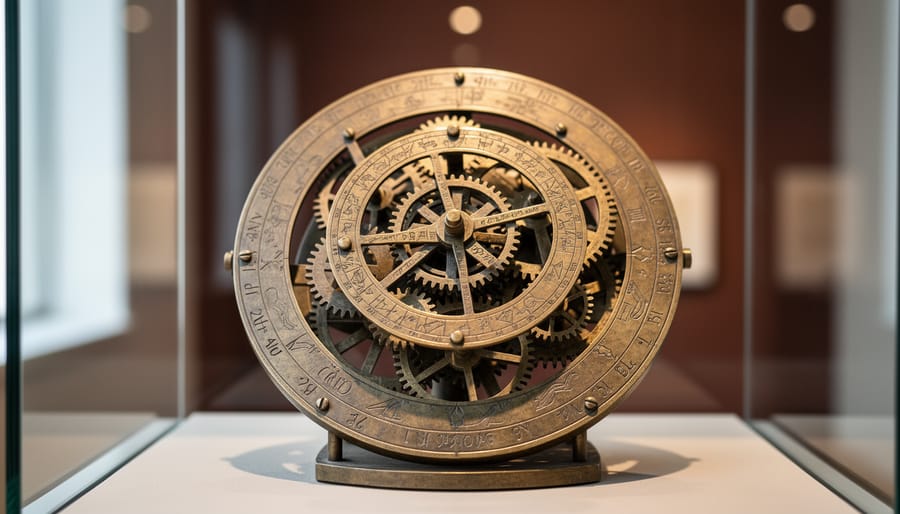
The Antikythera Mechanism is an ancient Greek machine, built more than 2,000 years ago, that used a train of interlocking bronze gears to model the movements of the heavens. Often described as the world’s first analog computer, it turned the turn of a single crank into predictions about the sky, a task no one expected the ancient world’s craftsmen to have mastered.
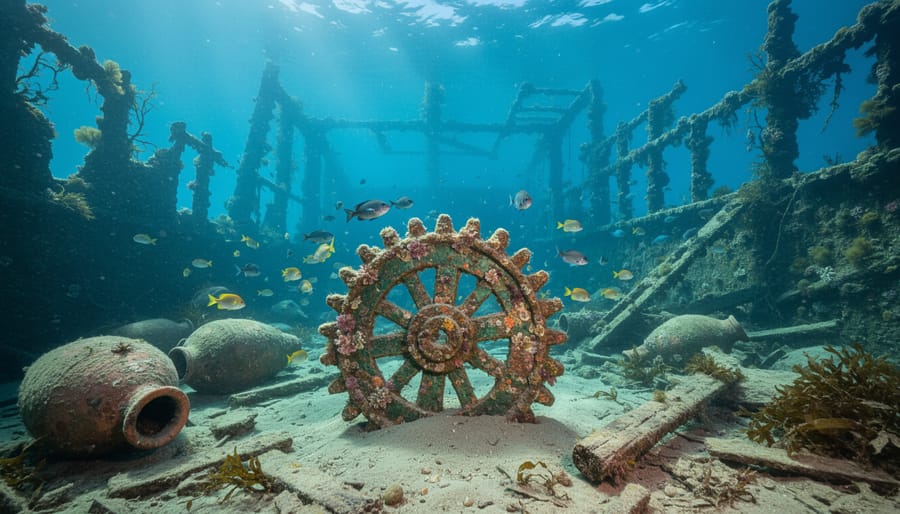
Its story begins in 1901, when divers pulled a corroded lump from an ancient shipwreck. Nothing about it looked remarkable. Yet inside that crust of salt and bronze sat a mechanism so intricate that scholars have spent generations working out what it did and how.
The topic is back in the spotlight because a British museum curator has built a working replica of this 2,000-year-old machine, giving the public a rare chance to see its logic in motion rather than only in fragments. That’s a powerful way to understand it, much like seeing a voyageur’s canoe on the water instead of behind glass.
In this guide, you’ll find a plain-language definition, a look at how the gears work together, the parts that make up the device, and what it was likely used for. Think of it as the kind of story that belongs in classrooms from Halifax to Victoria, and a favourite for anyone who loves watching museums and researchers collaborate to bring the past to life. Have questions of your own? Keep them handy, because the FAQ near the end is built to answer them.
What the Antikythera Mechanism Means: A Plain-Language Definition
The Antikythera Mechanism is an ancient Greek machine, built more than 2,000 years ago, made of interlocking gears that modelled the movements of the heavens. Turn a hand crank, and a chain of linked wheels set pointers moving on dials. Each pointer stood in for something happening in the sky or on the calendar. It is a little like a pocket watch, except that its job was to follow the heavens rather than the hours.
So what does “analog computer” mean? Think of a machine that shows natural cycles through physical motion rather than through digital code. A modern laptop stores numbers as ones and zeros. This device did something more hands-on: its gears turned together, and their motion mirrored the rhythms it was built to track. When scholars call it a “computer,” they use the word in a historical sense. They mean a device that calculated and predicted, not one with a screen or a keyboard.
Its story begins in 1901, when divers pulled a corroded lump from an ancient shipwreck. Few people could have guessed what lay inside. Those fragments revealed craftsmanship that astonished researchers, and a British museum curator has since built a working replica of the machine, often called the world’s first computer.
A few terms come up again and again when people talk about it:
- Analog computer
- A machine that represents natural cycles or quantities through physical motion, such as turning gears, instead of through digital numbers.
- Gear train
- A series of toothed wheels linked together so that turning one makes the others turn at carefully matched speeds.
- Astronomical cycle
- A pattern in the sky that repeats over time, like the changing phases of the moon.
- Calendar
- A system for organizing days, months and years, often tied to the sun and moon.
- Shipwreck recovery
- The careful lifting of objects from a sunken vessel, as when divers brought up the mechanism’s fragments in 1901.
With those terms in hand, the idea is easier to picture. Where we now see a glowing screen, ancient craftsmen built a mechanical model of the cosmos that a person could hold, turn and read.
From the Seabed to the Museum: The Story of Its Discovery
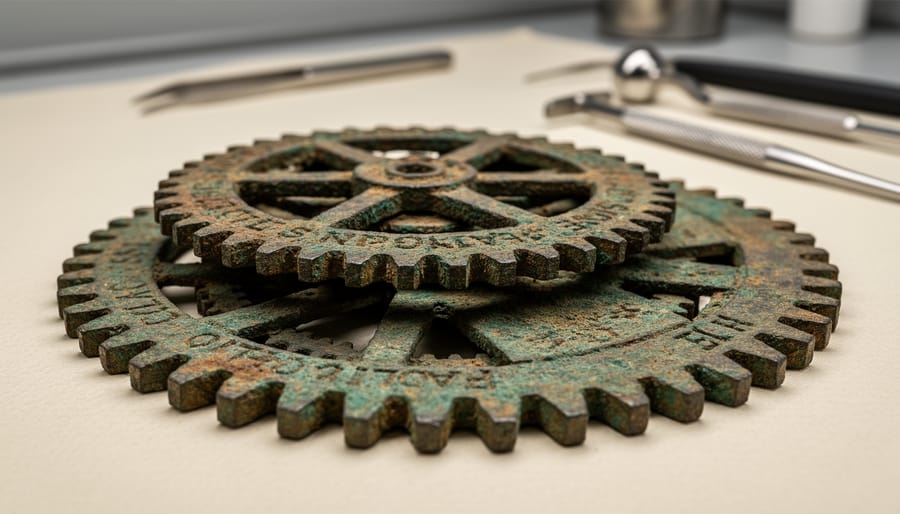
A Corroded Lump From an Ancient Wreck
In 1901, divers working near the Greek island of Antikythera hauled up something that looked like nothing at all: a corroded lump from an ancient shipwreck. The wreck itself had been discovered off Antikythera and most of what came from it was easy to understand. The lump was not.
Crusted and fused by centuries underwater, it had no obvious shape, purpose or label. It had no place among the statues and pottery that made the recovery famous. Nothing about it announced that it belonged to a machine built more than 2,000 years ago, by craftsmen whose skill the ancient world was never expected to match.
Think of a fragment of an old archival document, so damaged that you can’t yet tell what it records. You set it aside, treat it with care, and return to it later. That patience is how the puzzle began to give way.
Who Built It, and When?
The Antikythera Mechanism was built more than 2,000 years ago and that is the firmest date we can offer. Beyond it, the details get hazier, and honesty about that is part of telling the story well.
What we can say is that ancient craftsmen made it, and they were extraordinarily skilled. Nothing else we know of from that world looks quite like it, which is exactly why the discovery stunned researchers.
What we can’t say is who those craftsmen were, or precisely when and where they worked. No maker’s name has settled the question, and scholars continue to discuss it. Rather than guess, it’s better to let the object speak for itself. The precision of the work shows a tradition of fine mechanical skill that left few other traces. For now, the makers remain anonymous, and the machine is their lasting signature.
How the Antikythera Mechanism Works: Gears, Dials, and Heavenly Cycles
Turning the Crank: The Mechanical Idea
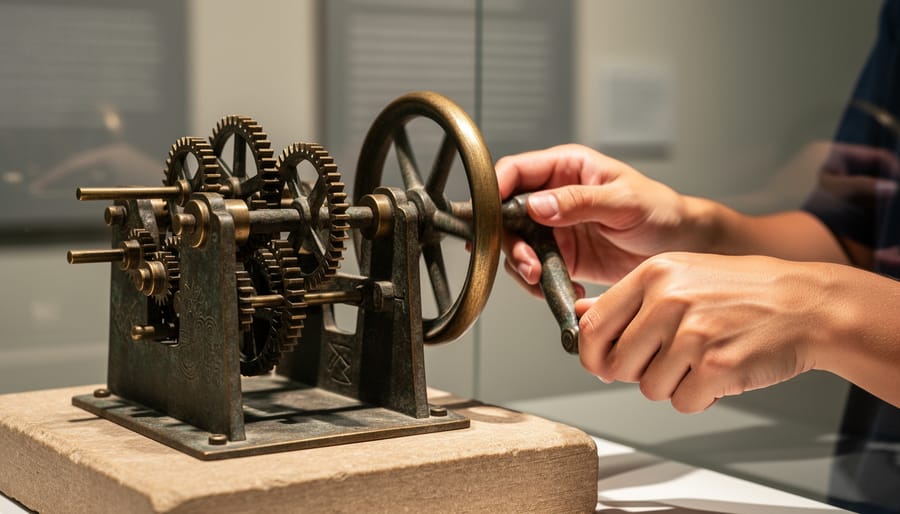
Imagine a single motion of your hand setting a whole small universe in motion. That is the core idea behind the Antikythera Mechanism. A user turned a crank, and that one steady movement travelled into the machine’s interlocking gears. Each gear had a different number of teeth, so each one turned at its own pace, a bit like the wheels inside an old pocket watch or a cuckoo clock.
Here is the clever part. When a small gear meshes with a larger one, the larger gear turns more slowly. Chain several of these pairings together, and a single turn of the crank becomes many coordinated motions, each moving at a different rate. Think of a hand-cranked music box, where one winding sets countless tiny parts moving in harmony.
This is the sense in which scholars call it an analog computer. Nothing was typed in or calculated digitally. The machine represented natural cycles through physical motion, so the gears themselves stood in for the rhythms they modelled. For ancient craftsmen to build something so precise, more than 2,000 years ago, remains remarkable. It shows how much careful thought and fine metalwork lay behind a device powered by nothing more than a human hand.
Reading the Dials: What Users Could See
Picture the machine as a wooden-cased box with faces on both sides, and a pointer or two moving on each. That is roughly how scholars describe it. The front is generally understood to have shown the passing of the year and the positions of the sun and moon against a scale of the heavens. Think of it as a kind of calendar you could read at a glance.
The back is where things get more intricate. Researchers usually describe spiral-shaped dials there, each tracking a longer rhythm, such as the repeating cycles of the moon and the timing of expected eclipses. Reading these meant following a pointer along a winding track, a bit like tracing the groove of a record.
Honest caution is needed here. The original survives only in corroded fragments, so some inscriptions are worn, and scholars still debate certain details, including exactly what every dial displayed. What we can say is that the dials turned hidden gearwork into something a person could read, and that is what makes the machine feel so modern.
Inside the Machine: Main Parts and What Each One Did
What survives of the Antikythera Mechanism is a puzzle box of corroded bronze, and each piece tells part of the story. Because the original came out of the sea in 1901 as a heavily corroded lump, it exists today in fragments rather than as a complete machine. That is why scholars rely on careful study and reconstruction to picture how all the parts once fit together.
Here are the main components and what each one did:
- Gearwork: interlocking toothed wheels that passed a single turn of the crank into many coordinated motions.
- Dials: circular scales that displayed calendar and sky-related cycles for the user to read.
- Pointers: slim indicators that moved across the dials to mark the current position of each cycle.
- Protective case: a wooden-style housing that shielded the delicate mechanism and framed its faces.
- Inscriptions: engraved Greek text that labelled the dials and likely guided the person using the device.
The gearwork is the heart of the machine. Think of the hidden wheels inside an old pocket watch, only far older and built entirely by hand. Every tooth had to be cut with patience and precision, which speaks to the skill of those ancient craftsmen.
The engraved writing deserves special attention. Fine lettering cut into metal reminds me of the delicate detail found in scrimshaw art where small, careful marks carry big meaning. In the same way, these tiny inscriptions help researchers decode what the dials were meant to show.
Piecing all of this together is slow, shared work. Museums and researchers examine each fragment, compare notes, and test ideas, much as historical institutions across Canada collaborate to preserve and interpret their own treasures.
Rebuilding the Past: Replicas and the Working Model Making Headlines
A British museum curator has now built a working replica was built of the 2,000-year-old Greek machine, the device that has often been called the world’s first computer. It is the kind of story that pulls an old corroded lump back into the headlines.
Why does a replica matter? The original survives only in fragments, so scholars can’t simply turn its crank and watch it run. Building a working copy forces a question the fragments alone can’t answer: do these gears really fit together and move the way we think they did? A replica lets researchers test ideas, spot problems, and see how a hand-turned crank might have set many pointers moving at once. For the rest of us, it turns an abstract diagram into something we can watch and understand.
A word of caution. Exhibition dates, location, organizer, and ticket details are not confirmed here, so we won’t guess at them. If you’re hoping to see a replica in person, check with the museum directly before making plans.
What this story does show is the value of collaboration. Careful work by museums, researchers, and archives is what lets fragile objects and records speak again. We see the same thing in our own partnerships with institutions like the Archives of Manitoba, where patient preservation keeps Canadian stories within reach for future generations.
Why It Still Matters: Uses, Lessons, and Connections to Canadian Curiosity
A Classroom and Museum Teaching Tool
Museums and classrooms have found that few objects start a conversation like the Antikythera Mechanism. A 2,000-year-old machine pulled from a shipwreck in 1901 invites students to ask who built it, what it measured, and how anyone could make something so intricate by hand. That curiosity naturally spreads across history, astronomy, and engineering.
Working replicas add to the effect. When a British museum curator builds a functioning model of this ancient Greek machine, learners can see gears turn and imagine how the original behaved. Educators can pair a replica with simple paper gear templates or a discussion about early technology.
Many teachers already rely on creative teaching tools like these to bring the past to life, turning a single artifact into a lesson that students remember.
Looking Up From Coast to Coast to Coast
Long before anyone built a gear train to model the heavens, people across this land were reading the sky. In the Maritimes, fishing families have long judged weather and tides by the moon and stars. In Quebec and Ontario, trappers and voyageurs once found their way along lakes and rivers beneath the same constellations. Prairie farmers watched the sky for the turning of the seasons, and on the West Coast, communities tied the rhythms of salmon and cedar to the heavens above.
In the North, where winter nights stretch long, Inuit and other Northern peoples have passed down detailed knowledge of the stars, a vivid example of Indigenous ways of knowing shaped by generations of careful observation. Different tools, one shared curiosity.
Common Questions About the Antikythera Mechanism
What is the Antikythera Mechanism?
It is an ancient Greek machine built more than 2,000 years ago, made of interlocking gears turned by hand. It was designed to model the movements of the heavens and track the passage of time.
How old is it?
The mechanism is more than 2,000 years old. Divers pulled it from an ancient shipwreck in 1901 as a heavily corroded lump.
What could it do?
When a user turned its crank, the gears moved pointers across dials to show cycles of the sun, moon, and calendar. Scholars are still studying the finer details of what every dial displayed.
Who built it?
Skilled ancient Greek craftsmen made it, though the exact individuals remain a matter of scholarly debate. What we can say is that their work was unlike anything people expected from the ancient world.
Is it truly a computer?
Not in the modern sense. It ran on gears, not electricity or digital code, so it is better described as an analog computer, which is why a British museum curator’s working replica has been called the world’s first computer.
Still have a question we have not covered? Share it with us, and we will happily fold it into a future article.
A corroded lump pulled from a shipwreck in 1901 looked like nothing worth keeping. Yet inside that crust of bronze and sediment was a machine built more than 2,000 years ago, a hand-turned set of gears that modelled the rhythms of the sky. That is the quiet astonishment of the Antikythera Mechanism: an ancient Greek analog computer that reminds us how much careful thought and craftsmanship the distant past could hold.
Stories like this matter because they stretch our sense of what people were capable of. They also depend on patient work. Divers, conservators, researchers and museum curators, including the one who has now built a working replica, turn fragile fragments into knowledge anyone can share.
That same patient work is what we try to honour here at Lakes & Woods, whether the object is a Greek mechanism or a letter tucked into a Canadian archive. If this story sparked your curiosity, there are easy ways to keep going:
– Subscribe to our newsletter for new stories from the past, delivered straight to you.
– Explore our related historical articles to follow other threads of discovery.
– Consider supporting our archiving and donation efforts, which help preserve records and artifacts for future generations.
– Browse our travel offers to historical locations and see the past for yourself.
The sky has always invited questions. We hope you keep asking them.