
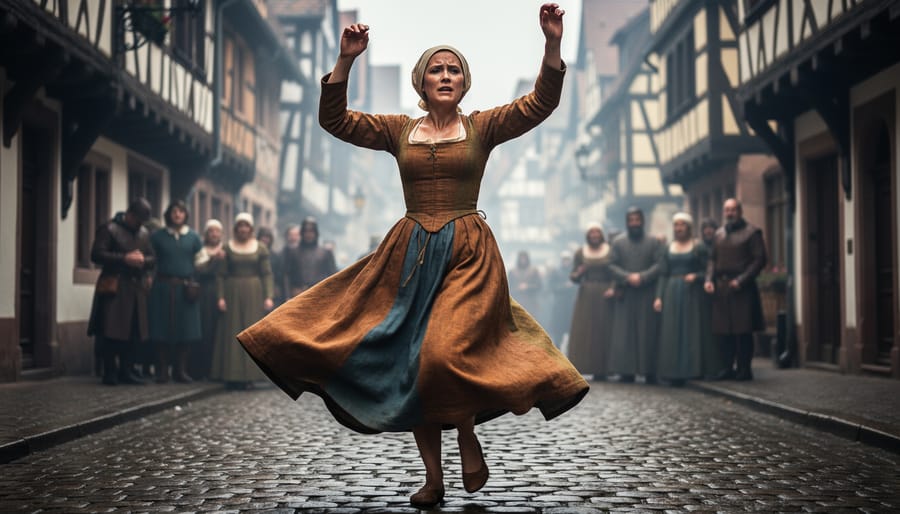
The dancing plague of 1518 was an outbreak of compulsive, uncontrollable dancing that struck the city of Strasbourg, then part of the Holy Roman Empire, in July 1518. It began in a street, when a woman known as Frau Troffea started dancing fervently and for no apparent reason. Soon others in the city were seized by the same urge.
Nothing about it was a festival or a performance. People who couldn’t stop moving were caught in something their neighbours could neither explain nor halt, and that puzzle still draws historians, teachers and curious readers five centuries later.
Explanations came quickly and have kept coming. Those living through it blamed demonic possession and overheated blood. Historian John Waller, working from the evidence, concludes that the dancers were probably suffering from stress-induced psychosis. The gap between those two answers shows how differently each era understands the mind and the body.
This article lays out what happened, how the competing explanations compare, and why the episode remains a staple of history classrooms. If you’ve ever taught a unit on early modern Europe, or simply wondered what could make a city dance, start here.
What the Dancing Plague of 1518 Means: A Plain-Language Definition
The “dancing plague of 1518” is the name given to an outbreak of compulsive, seemingly uncontrollable dancing that began in July 1518. It started in a street in Strasbourg, when a woman known as Frau Troffea began to dance fervently and, as far as anyone could tell, without any reason. Soon after, other residents of the city were struck by the same sudden urge. Historians often call this kind of event “dancing mania.”
The word “plague” can mislead. Here it doesn’t point to an infectious disease like the one that haunted medieval Europe. It carries an older, broader meaning: a sudden affliction that spreads through a community and that people struggle to explain.
To follow the story, a few terms help:
- Dancing plague
- The popular name for the July 1518 outbreak of compulsive dancing in Strasbourg.
- Dancing mania
- The wider term historians use for episodes of uncontrollable, group dancing like this one.
- Holy Roman Empire
- A large patchwork of territories and cities in central Europe, of which Strasbourg was then a part.
- Psychosis
- A state in which a person loses firm contact with reality; historian John Waller suggests the dancers were probably suffering from the stress-induced kind.
- Contemporary explanation
- An explanation offered by people living at the time, such as demonic possession or overheated blood.
Strasbourg in the early sixteenth century was not part of France as we know it today. It sat inside the Holy Roman Empire, a world with its own laws, beliefs and ways of understanding the body. That context matters, because the people who watched the dancers made sense of what they saw through the ideas of their era. Modern historians weigh those contemporary explanations alongside newer interpretations, and the comparison is part of what makes the episode such a compelling story to teach.
How the Outbreak Unfolded in Strasbourg
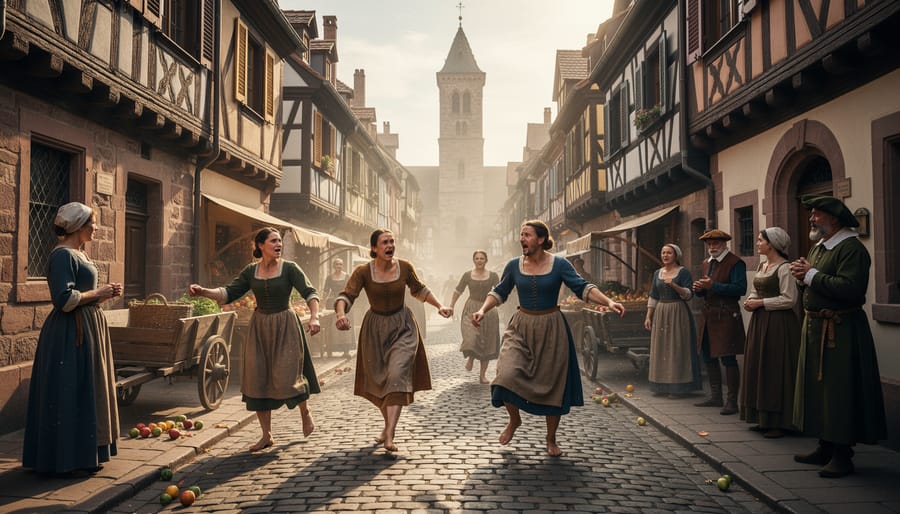
In July 1518, a street in Strasbourg became the stage for one of history’s strangest episodes. At the time, the city belonged to the Holy Roman Empire, a patchwork of territories that stretched across much of central Europe. Into that ordinary urban setting stepped a woman known to us as Frau Troffea.
According to the surviving accounts, Frau Troffea began to dance fervently and uncontrollably, apparently without any reason. There was no festival, no music we can point to, and no obvious cause that onlookers could name. She simply danced, and what she did could not be dismissed as a passing whim.
Then something spread. Residents of Strasbourg were struck by a sudden and seemingly uncontrollable urge to dance, and what began with one woman grew into an outbreak that gave the episode its enduring name. The word “plague” here describes a sudden affliction sweeping through a community, not an infectious disease passed from person to person.
It helps to be clear about what the sources do and do not tell us. We know the month, the city, the street setting, and the name by which the first dancer is remembered. We do not have reliable figures for how many people joined in, and we should be wary of any retelling that offers exact numbers or tidy timelines. Good historical storytelling stays within the evidence, and the evidence here is both vivid and limited.
That combination of a clear starting point and a deliberately unclear scale is part of why the story still fascinates teachers and students. It invites us to ask what a community was experiencing, and to practise the careful, patient habit of separating what the record shows from what later tellings have added.

Explanations Then and Now: Types of Causes Offered for the Dancing Plague
How People in 1518 Understood It
To the people of Strasbourg in 1518, the dancing was not a medical puzzle to be solved with tests. It was a sign that something had gone wrong in the body or the soul, and the available explanations reflected that worldview. Contemporary accounts pointed to demonic possession and overheated blood, two ideas that fit comfortably into early sixteenth-century thinking.
- Demonic possession: the belief that a spiritual force had seized control of a person’s body and will.
- Overheated blood: the belief that the body’s inner balance had tipped, driving the blood to a feverish state.
- Stress-induced psychosis: the modern conclusion of historian John Waller, who reasons that the dancers were probably suffering from this.
Why did these ideas make sense? In a world where faith shaped daily life and medicine rested on the balance of bodily fluids, an affliction with no visible cause called for a spiritual or physical remedy. Watching a neighbour dance without reason, people reached for the frameworks they trusted, which is exactly what makes the episode so revealing to read today.
What a Modern Historian Concludes
Historian John Waller, who has studied the episode closely, concludes that the dancers were probably suffering from stress-induced psychosis. In plain terms, that means a mind under severe, prolonged pressure can break from ordinary thought and behaviour, leaving a person unable to control what their body does. Waller’s reading ties the outbreak to the strain felt by the people of Strasbourg, then a city within the Holy Roman Empire, and it fits the way a sudden, shared urge to dance could spread from one woman to the people around her.
It is worth holding this conclusion lightly. The word “probably” matters. Waller offers an interpretation built from surviving evidence, not a final verdict, and the records from 1518 cannot confirm what any dancer actually experienced. Historians treat his view as a thoughtful answer to an old question, one that sits beside the older beliefs about demonic possession and overheated blood rather than closing the matter for good.
Why the Dancing Plague Still Matters to Historians and Teachers
The dancing plague of 1518 earns its place in history classes because it asks a question every society eventually faces: what do we do when something happens that nobody can explain? In July 1518, residents of Strasbourg were struck by a sudden urge to dance, and the people of the day reached for the explanations their world offered, demonic possession and overheated blood. A modern historian, John Waller, concludes the dancers were probably suffering from stress-induced psychosis. Set side by side, those readings show how belief shapes what a community is able to see.
For historians, the episode is also a lesson in weighing evidence. We know the outbreak began with a woman called Frau Troffea dancing in a street in Strasbourg, yet much beyond that rests on fragmentary records. Learning where the sources are firm and where interpretation takes over is exactly the habit good historical thinking depends on.
That makes it a rich prompt for classroom discussion. Students can ask how stress, belief and community pressure might feed one another, and why a medical explanation and a spiritual one can both feel convincing in their own time. Comparing different cultural perspectives on the same event, and the distinct ways of knowing that communities rely on, sharpens that skill further.
The lesson travels well to Canada. Archives such as the Archives of Manitoba, along with libraries and museums from the Maritimes to British Columbia and the North, safeguard the letters, registers and recordings that let later generations study moments of collective hardship. At Lakes & Woods, we believe that work is best done together, in collaboration with historical institutions that keep those records alive for the questions still to come.
Common Questions About the Dancing Plague of 1518
Curious readers often arrive with the same few questions, and the verified record answers some of them better than others. Here are the most common, handled with care.
What was the dancing plague of 1518?
It was an outbreak of compulsive dancing that began in July 1518 in a street in Strasbourg, then part of the Holy Roman Empire. A woman known as Frau Troffea began to dance fervently and uncontrollably, and residents of the city were soon struck by a sudden urge to dance too.
What caused Strasbourg’s dancing plague of 1518?
People at the time pointed to demonic possession and overheated blood. Historian John Waller concludes that the dancers were probably suffering from stress-induced psychosis, though this remains an interpretation rather than settled fact.
Why did people dance themselves to death?
The verified facts we rely on here do not establish how many dancers died, so it is wise to be cautious with dramatic figures repeated online. What the record does show is the sudden, seemingly uncontrollable urge to dance that gripped the city.
Questions like these are exactly why the episode rewards a closer look. Each answer leads to a deeper one: how people of the time understood affliction, how historians weigh evidence, and how a single street scene can still spark debate centuries later. If a question lingers for you or your students, follow it into the archives and see where the sources lead.
A single street in Strasbourg, a July in 1518, and a woman known as Frau Troffea who began to dance without any apparent reason. From that moment, a city was swept up in something its people could only explain through possession and overheated blood, and which historian John Waller now reads as probably stress-induced psychosis. The mystery is still debated, and that is part of its pull.
What keeps such stories alive is the evidence we choose to protect. Every preserved record gives the next generation a chance to ask better questions. Subscribe to the Lakes & Woods newsletter, explore our related historical articles, and consider our history travel offers to step into the places where these stories happened.